.jpg) The Jeep Grand Cherokee CRD’s 3.0-liter turbo diesel certainly lets you know it’s an oil burner with some of that familiar clatter. But it’s unobtrusive by diesel light truck standards. There’s only a whiff of diesel exhaust, too, contributing to what is a very palatable drive for this kind of engine. All this gives you 376 lb.-ft. of torque. Acceleration is pretty decent, but the transmission is just OK. Jeep does equip the Grand Cherokee with front and rear locking differentials for ambitious off-road use.
The Jeep Grand Cherokee CRD’s 3.0-liter turbo diesel certainly lets you know it’s an oil burner with some of that familiar clatter. But it’s unobtrusive by diesel light truck standards. There’s only a whiff of diesel exhaust, too, contributing to what is a very palatable drive for this kind of engine. All this gives you 376 lb.-ft. of torque. Acceleration is pretty decent, but the transmission is just OK. Jeep does equip the Grand Cherokee with front and rear locking differentials for ambitious off-road use.There’s no mistaking that you’re in a truck from a ride and handling standpoint, it’s still a comfortable ride. The suspension’s on-road manners are soft and vague, as is typical of a 4WD vehicle. Some mushiness on the highway is forgivable for something that’s suited to more hostile terrain..jpg)
Where the Grand Cherokee comes up short isn’t in the drivability, it’s the interior. Even without the optional common rail turbo diesel, this is a $39,000 truck with the interior befitting something closer to $29,000. Sure, all the controls are logical and well marked, but they feel cheap. The overall interior appearance is cheap. As it is, this is a $42,000 truck that has one real advantage: the diesel engine, and it’s a very good one. But that alone isn’t enough to make the Grand Cherokee CRD a remarkable vehicle.
.jpg)
To be fair, the Grand Cherokee that arrived for our test drive was a different trim level and had the Common Rail Diesel (CRD) powerplant. I’m always up for torque, and the CRD provides plenty. It grunts its way up hills and over ruts without breaking a sweat and you experience it with all your senses, feeling the vibration, hearing the low growl, seeing the tires easily digging into tough terrain, the taste of victory as it bests each obstacle you throw out it and unfortunately an occasional whiff of diesel fume. It’s nothing like the diesels of yore, but every once in awhile the wind catches it just right. There is a bit of the telltale diesel clatter, but it is pitched just right with the exhaust note that it compliments it rather than detracts from it -- it sounds beefy.
As much testosterone as this beast puts out, there is one place it just doesn’t perform up to it its internal combustion brothers: the pavement. Mash the go pedal to the floor, count to three and then you will finally start to take off. Unacceptable if you need to make a quick turn across traffic, you better go find a traffic light to stop those oncoming cars so you can get across safely. The biggest benefit of the diesel for most users is supposed to be increased mileage. On one highway trip, one of our editors achieved a little over 20mpg. I averaged 17.9 mpg in my 3.7-liter V-6 rental traveling over interstates. Two mpg just doesn’t seem to be enough of an increase to justify the diesel expense, especially with this amount of acceleration lag. Once the GC CRD is moving, however, there is plenty of power for passing.
.jpg)
A fair amount of body roll is present, but necessary to float the vehicle to give it a nicer ride, and the Grand Cherokee does ride better than most SUVs. The steering is a little ponderous and requires occasional input to keep it traveling in a straight line. A slight amount of wind noise, and a pleasing amount of engine noise are inside the cabin, but it’s quieter than a crowd watching Tiger Woods putt.
.jpg)
.jpg)
.jpg)
The Grand Cherokee is exactly what the name says it is, grand. Comfort and capability are seldom rolled so nicely into one package. As much as I love the macho sound of the CRD, and the grunt of its torque, it just doesn’t seem to be enough to justify the $42,000 price tag. Rumor has it that there is a Bluetec diesel in the GC’s future. If you really have to have a diesel Grand Cherokee, I’d wait until then and see how well it starts from a dead stop. Otherwise, give me gas… and I mean that in a good way.
Regardless, The Jeep Grand Cherokee CRD makes a strong case for modern diesel technology on several fronts. Available in three trim levels—Laredo, Limited, and the uplevel Overland—this highly sought-after SUV is now cleaner, greener, and more work-capable than ever..jpg)
.jpg)

 Diesel will grant the BMW X5 xDrive35d better fuel economy (as much as a 30 percent improvement to 19 city/26 highway) and higher torque than its gas-powered counterpart. This means the performance-tuned X5 diesel will have even greater acceleration and more low-end pulling power than ever. All while making cleaner emissions a reality.
 The advanced diesel system will utilize BluePerformance urea injection, which will allow the BMW X5 xDrive35d to be sold in all 50 states, even those following California's strict emissions standards. BluePerformance uses a solution called AdBlue, that is injected into the exhaust gas to turn nitrous oxides into nitrogen gas and water vapor. This works in conjunction with a particulate filter to further reduce emissions. The system works on virtually the same technology that Mercedes-Benz uses in its upcoming Bluetec SUVs.


 The lines have worn so well that the current generation M opted for an evolutionary look, keeping the same sporty stance and raked forward C-pillar but adding more pronounced wheelarches and a rising swage line along its flanks that may look a little too Toyota RAV4 for more conservative tastes. It marks a definite swing towards the sports end of the sports utility market and differentiates the Mercedes nicely from cars like the Land Rover Discovery and the Volkswagen Touareg. The next X5 will have its work cut out to offer styling quite as slick as the M-Class. Although the sharply raked back windscreen and contoured body panelling give the M-Class a sporty, compact appearance, the tape measure shows just how artful its stylists have been.
  Although its not what youd call packed with surprise and delight features, the cabin now befits a vehicle of this class. If you can overcome the upfront price, the ML320CDI is surprisingly affordable to run. Insurance is manageable, fuel economy is good and the residual values look set to be so strong that the all-important pence per mile figure looks very favourable. Whoever said the best things in life are free had obviously never driven a Mercedes ML320CDI.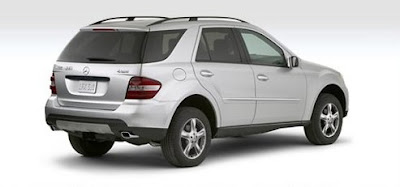


 Posts
Posts

